Download PDF Agnosticism: A Very Short Introduction
Reading a book Agnosticism: A Very Short Introduction is sort of very easy activity to do each time you really want. Even reading every time you want, this activity will not disrupt your various other tasks; many individuals commonly read guides Agnosticism: A Very Short Introduction when they are having the leisure. Just what regarding you? Just what do you do when having the extra time? Do not you invest for ineffective things? This is why you have to obtain the book Agnosticism: A Very Short Introduction and also aim to have reading habit. Reviewing this publication Agnosticism: A Very Short Introduction will not make you pointless. It will certainly give more benefits.
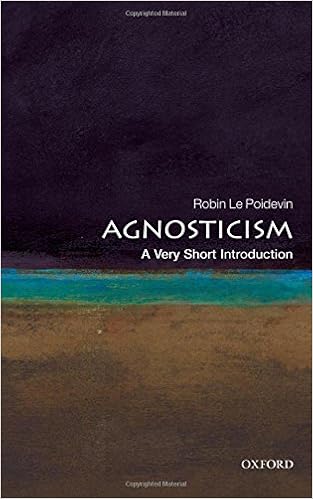
Agnosticism: A Very Short Introduction

Download PDF Agnosticism: A Very Short Introduction
It's coming again, the new collection that this site has. To finish your curiosity, we provide the preferred publication as the selection today. This is a publication that will certainly show you even brand-new to old point. Forget it; it will be right for you. Well, when you are actually dying of Agnosticism: A Very Short Introduction, just pick it. You recognize, this book is constantly making the fans to be dizzy if not to discover.
A book is much related to reviewing activities. Schedule will be absolutely nothing when none reads it. Checking out will certainly not be completed when the book is just one of the topics. Nevertheless, in this contemporary age, the visibility of book is growing sophisticatedly. Several resources make the both publication in printed as well as soft file. Having the soft file of book will ease you to make real to review it. It can be saved in your different gadget, computer, CD, laptop computer, also the gadget that you always bring everywhere. It is why; we reveal you the soft data of Agnosticism: A Very Short Introduction as one of issue to read.
The book can be prepared to have such ideas that could make different things to keep in mind. One is that good author constantly offer the inspiring flow, good lesson, as well as impressive web content. And also just what to give up Agnosticism: A Very Short Introduction is more than it. You could specify just how this book will gain and also meet your desire about this relevant subject. This is the means exactly how this publication will certainly affect people to enjoy it a lot. After finding the reasons, you will certainly love an increasing number of regarding this publication as well as writer.
After obtaining some factors of how this Agnosticism: A Very Short Introduction, you have to feel that it is very appropriate for you. However, when you have no idea about this book, it will certainly be much better for you to try reading this publication. After reviewing page by web page in just your leisure, you could see exactly how this publication will work for your life.
Product details
Paperback: 152 pages
Publisher: Oxford University Press; 1 edition (November 19, 2010)
Language: English
ISBN-10: 9780199575268
ISBN-13: 978-0199575268
ASIN: 0199575266
Product Dimensions:
6.6 x 0.2 x 4.2 inches
Shipping Weight: 5.6 ounces (View shipping rates and policies)
Average Customer Review:
4.0 out of 5 stars
9 customer reviews
Amazon Best Sellers Rank:
#370,894 in Books (See Top 100 in Books)
It seems somewhat clear what an atheist is and a theist is if you ask the average person on the street. (Though how much that is worth will vary by person of course.) An atheist is a person who believes there is no God and a theist is a person who believes that there is a God. But what exactly then of a person who is not sure and not willing to make a commitment one way or the other? Such a person would be labeled an agnostic most likely. But is this an accurate definition? And don’t agnostics deserve to define themselves and their world view?Such is the question in chapter one of Robin Le Poidevin’s book Agnosticism: A Very Short Introduction. If agnosticism is simply a refraining from answering a question, then it is not a viewpoint at all and certainly not in need of a book explaining it. But agnosticism is not simply being a fence sitter, as Le Poidevin points out. Agnosticism, as defined by Le Poidevin, is “The principle never to claim certainty for anything for which one does not have adequate justification: that is the agnostic principle.†(pg.26) Le Poidevin’s definition is similar to one given by David Hume (who Thomas Huxley, the father of agnosticism, called “The Prince of the Agnostics) in his essay Of Miracles where he states that a wise man is a person who proportions their belief to the evidence.Le Poidevin then gives a brief history of agnosticism, showing how the name itself was coined by Thomas Henry Huxley in the nineteenth century as an attempt to define his position to those who claimed to know for certain the truth of how the world is in itself. But as it turns out, Huxley’s view was an old one with a new name, since such philosophers as Pyrrho, Hume, and Immanuel Kant had also stated that it was impossible to know for sure whether or not God exists.The most powerful point that Le Poidevin makes in his brief book is towards the end, when he shows that being an agnostic is not incompatible with being a believer. He writes:A religious life, then, is possible for the agnostic, and not simply as a cautious, experimental, ultimately detached affair. But of course it is not obligatory. Many agnostics may find that they are psychologically unable to take this imaginative and emotional step. (pg. 107)Why is this the case? Because agnosticism is about the question of knowledge, not about belief. We believe many things because we think there is sufficient evidence for them, but does that mean that we are sure beyond a shadow of a doubt that we are right? Most of the time the answer is no. So, a person can say that they believe in God while at the same time admitting that they are not 100 percent sure of whether or not God exists.The one part of the book that I strongly disagreed with was in his closing chapter “How should agnosticism be taught?†In that chapter he notes that while he agrees that Intelligent Design Theory should not be discussed in biology classrooms, he is okay with it being discussed somewhere in the curriculum. In the age of climate change denial and fake news, this is a dangerous thing to do. Science, which depends on both verification and falsification, is not possible with intelligent design, and it is a religious doctrine veiled as science as multiple authors such as Jerry Coyne and Michael Shermer have written at book-length. We have a limited time to teach students, and if we spent countless hours discrediting false theories, when would we have time to teach them facts?Aside from this disagreement, this book is very informative and will get you to think, which should be the goal of any book. I recommend it to atheist, agnostic, and theist alike, because it seems we all must grapple with the issues that Le Poidevin brings up. A truly commendable book.
"Agnosticism: A Very Short Introduction" is an excellent starting point for those who have little to no knowledge of what Agnosticism is all about. In this concise book, Prof. Robin Le Poidevin provides a well-rounded view of Agnosticism, as well as a brief cursory glance at its history, and explains how Agnosticism, as a position in the argument over whether or not God exists, is not merely a "spineless" and indecisive compromise between Atheists and Theists (on a sliding scale), but a formidable position (not on a sliding scale) that considers the pros and cons of the arguments for belief or disbelief from both sides, as well as its own, and makes no conclusive or compulsory claims where the evidence obviously demands further investigation. He also puts forward reasonable arguments that show the plausibility of a conclusion that stands in favor of a particular claim about the existence of God then contrasts it with the plausibility of a conclusion that stands in opposition to a particular claim about the existence of God, while leaving it open-ended for the reader to consider, by further investigation, then arrive at their own conclusions, even if those conclusions are themselves open-ended.An excellent book and a great place to begin a journey in gaining an unbiased and unskewed understanding of Agnosticism.
Wow! Robin Le Poidevin has done anyone that decides to pick up this book a favor. It is concise (118 small pages) but when you finish reading it, you will feel as if you have read a much larger book or a couple of books. His prose is accessible and extremely thought provoking.I purchased the book on a whim as part of the bundle of Atheism, Humanism, (and Agnosticism) in the Very Short Introduction Series and thought that this would be the worst and least engaging of the three (my apologies). This is anything but true.In fact, it was the most rewarding and thought provoking. It seems that today, most people are either theistic or atheistic in their beliefs and view persons that appeal to the agnostic approach to life as not wanting to take a side between these two views. This is really where the beauty of Le Poidevin's text shines.He makes the reader aware, almost immediately, that this way of thinking is really nothing more than a straw-man approach to those that define themselves as being agnostic. It turns out that agnosticism and agnostics in the mold of Le Poidevin (or perhaps all agnostics?) may have actually thought out their points of view with a greater level of sobriety than most theists and atheists have.He lays out the evidence for agnosticism in such an objective manner that one will find themselves having to delve deeply into what their own thoughts truly are. (Perhaps you are more of an agnostic than you realize?)This is a great little book. It has definitely broke my own dogmatic approach toward agnosticism.An exceptional book that explained and defined and approach to life that previously seemed to have only a minor ounce of integrity that I now have come to realize was anything but true. All this thanks to Robin Le Poidevin and the A Very Short Introduction series!
Good
The book ends in two fascinating chapters, and the culminating "Agnostic Manifesto" is an inspiring guide to leading a non-religious moral life.
"I do not deny. I do not know-but I do not believe." - Robert IngersollRobert Ingersoll was a master orator in an age when people paid to be entertained by speakers. Why I Am an Agnostic is not an intellectual treatise. It is written as if it were a lecture designed to entertain a paying audience for two hours. Judged on those terms, this little book is an entertaining read.
O.K. BUT COULD HAVE BEEN BETTER WRITTEN
Agnosticism: A Very Short Introduction PDF
Agnosticism: A Very Short Introduction EPub
Agnosticism: A Very Short Introduction Doc
Agnosticism: A Very Short Introduction iBooks
Agnosticism: A Very Short Introduction rtf
Agnosticism: A Very Short Introduction Mobipocket
Agnosticism: A Very Short Introduction Kindle